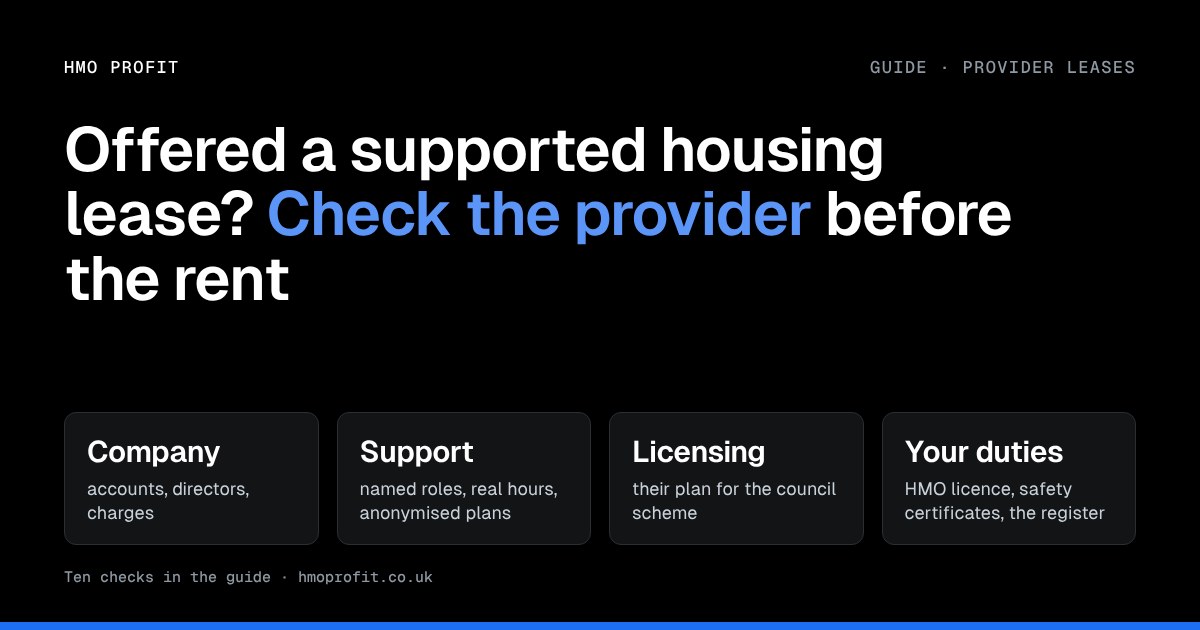
A supported housing provider offers to lease your property for five years at a fixed monthly rent, often above what a family let or an HMO would bring in. No voids, no tenant finds, no management. It can be a good arrangement. It can also leave you with an empty house and a provider that has stopped paying.
The difference is almost always the provider. This guide sets out what to check before you sign, and why the rules coming in make those checks more important, not less.
Why the provider matters more than the rent
In most of these schemes the residents' rent is paid through Housing Benefit at a higher "exempt" rate. That higher rate is only available where the landlord to the residents is a housing association, registered charity, voluntary organisation or non-metropolitan county council, and where that body, or someone acting for it, provides care, support or supervision. A private owner can't be that landlord, however much support residents receive. That is why commercial owners lease to a provider rather than letting directly.
It also means your rent depends on two things you don't control: the provider's status, and whether its support stands up. If the council decides support isn't being provided, the higher rent can stop, and a provider without other income may hand the keys back.
What is changing
The Supported Housing (Regulatory Oversight) Act 2023 received Royal Assent on 29 June 2023. It gives the government powers to set national standards for the support provided, and to let councils license supported exempt accommodation.
The government consulted on how to implement it in 2025 and published its response on 16 April 2026, updated on 19 June 2026. It proposes that licensing applies to supported exempt accommodation, with one licence per organisation in each council area. On 15 October 2026 it published a further consultation on the licensing regulations themselves.
If the scheme houses looked-after 16 and 17-year-olds or care leavers, the provider has had to be registered with Ofsted since 28 October 2023.
For an owner, the point is simple. A provider that can't evidence its support today will find licensing harder, and the rent behind your lease depends on it.
Ten checks before you sign
Who the provider is
- Company records. Look the provider up on Companies House. Check when it was incorporated, who the directors are, whether accounts are filed on time, and whether there are charges against it. Look at the directors' other companies too, including any that were dissolved.
- Registered provider status. Ask whether they are a registered provider of social housing, or which registered provider they lease through. You can check the Regulator of Social Housing's list of registered providers.
- Track record. Ask which councils they already work with, for how long, and for two landlords they lease from now. Then speak to those landlords.
The support
- Who delivers it. Ask for named roles and planned support hours per resident. "Floating support as needed" is not an answer.
- The paperwork. Ask to see two anonymised support plans with their latest reviews, and an anonymised needs assessment. A provider that is genuinely delivering support can produce these quickly without breaching anyone's privacy.
- Independent checks. Ask whether their support or property evidence has been independently audited, when, and what came out of it.
Regulation
- Licensing plan. Ask how they will meet licence conditions when your council's scheme starts, and whether they have read the council's published approach to exempt accommodation.
- The right registrations. Ofsted registration if the scheme houses 16 and 17-year-olds in or leaving care. CQC registration if they deliver personal care.
Your property and the lease
- What stays with you. An HMO licence, fire risk assessment, gas safety record, electrical certificate and EPC don't stop mattering because a provider holds the lease. Agree in writing who keeps each one current. The new landlord register, at £65 a property a year, is still yours to complete.
- The lease terms. Look for what happens to your rent if Housing Benefit is reduced or stopped, the notice period and any break clause, who holds repair and insurance liability, and the condition the property must be handed back in. Then have a solicitor review it.
Signs to slow down
- Guaranteed rent well above local market rent, with no explanation of how it is funded
- Support described in general terms, with nothing written down
- Pressure to sign before you have spoken to other landlords
- A lease that lets the provider hand back the keys at short notice
- No answer on licensing
Run the numbers as well
A provider lease still has costs: repairs outside the lease, a void if the provider leaves, dilapidations at the end, and the compliance that stays with you. Put the offered rent into the HMO Profit deal check and compare it with letting the same house as an HMO.
If you would rather not do the checks yourself, our provider review covers all ten, rates the provider red, amber or green, and gives you the lease points to take to your solicitor. The document request lists what to ask the provider for, whether or not you use us.
This is general information for England, not legal or financial advice. Have a solicitor review any lease before you sign.
Sources
- Bevan Brittan, "Supported Housing (Regulatory Oversight) Act 2023", 22 September 2026. https://www.bevanbrittan.com/insights/articles/2026/supported-housing-regulatory-oversight-act-2023/ (checked 17 November 2026)
- GOV.UK, "Supported Housing regulation: consultation – government response". https://www.gov.uk/government/consultations/supported-housing-regulation-consultation/outcome/supported-housing-regulation-consultation-government-response (checked 17 November 2026)
- Homeless Link, "Key changes to how supported housing regulations will be implemented". https://homeless.org.uk/news/key-changes-to-how-supported-housing-regulations-will-be-implemented/ (checked 17 November 2026)
- UK Parliament written question, "Supported Housing: Birmingham", answered October 2026. https://www.parallelparliament.co.uk/question/35568/supported-housing-birmingham (checked 17 November 2026)
- Department for Education, "Regulating supported accommodation for looked after children and care leavers aged 16 and 17". https://consult.education.gov.uk/regulating-supported-accommodation-team/regulating-supported-accommodation-looked-after (checked 17 November 2026)
- Supported Housing (Regulatory Oversight) Act 2023, section 12 (definition of supported exempt accommodation). https://www.legislation.gov.uk/ukpga/2023/26/section/12 (checked 17 November 2026)
- GOV.UK, "Register your rental property service: guidance for landlords". https://www.gov.uk/guidance/register-your-rental-property-service-guidance-for-landlords (checked 16 November 2026)